

The HEAD Residency 2024 forms an element of the TAS Hub and Good Systems Strategic Partnership (an RAi UK International Partnership project), focussed on multidisciplinary research impacting the USA and UK, addressing crucial challenges of AI, robotics, sensors, and other socio-technical applications in healthcare. The residency was led by Pepita Barnard, Research Fellow, Horizon, Computer Science, University of Nottingham (UoN), and Amanda Glazer and Arya Farahi, both Assistant Professors from the Department of Statistics and Data Science, University of Texas at Austin.
Some reflections on the residency, held 12-18th July 2024, from Pepi below:
We designed a seven-day residential workshop to be the key driver in establishing the HEAD (Health Equity in AI Decision) core team. The primary aim was to conceptualise and initiate projects that the HEAD community would champion over the following year to tackle significant challenges and address root causes of disparities at the intersection of public health and healthcare technology access and equity. This was achieved through a call for researchers to create a community, with a mission to develop collaborative research initiatives that will transform healthcare technology and public health worldwide. Our organic, people-centred approach enabled innovation in scientific research while helping members enhance their career paths and develop genuine relationships.
A centrally located venue in Matlock Bath, Derbyshire, was chosen to attract residents from across the UK, the USA, and other countries. We were 15 residents, composed of early career and senior researchers from health sciences, statistics, computer science, and various other related disciplines. Ten invited guests generously provided their expert input through planned sessions during the week. A live document was used to add content to planned program of activities.
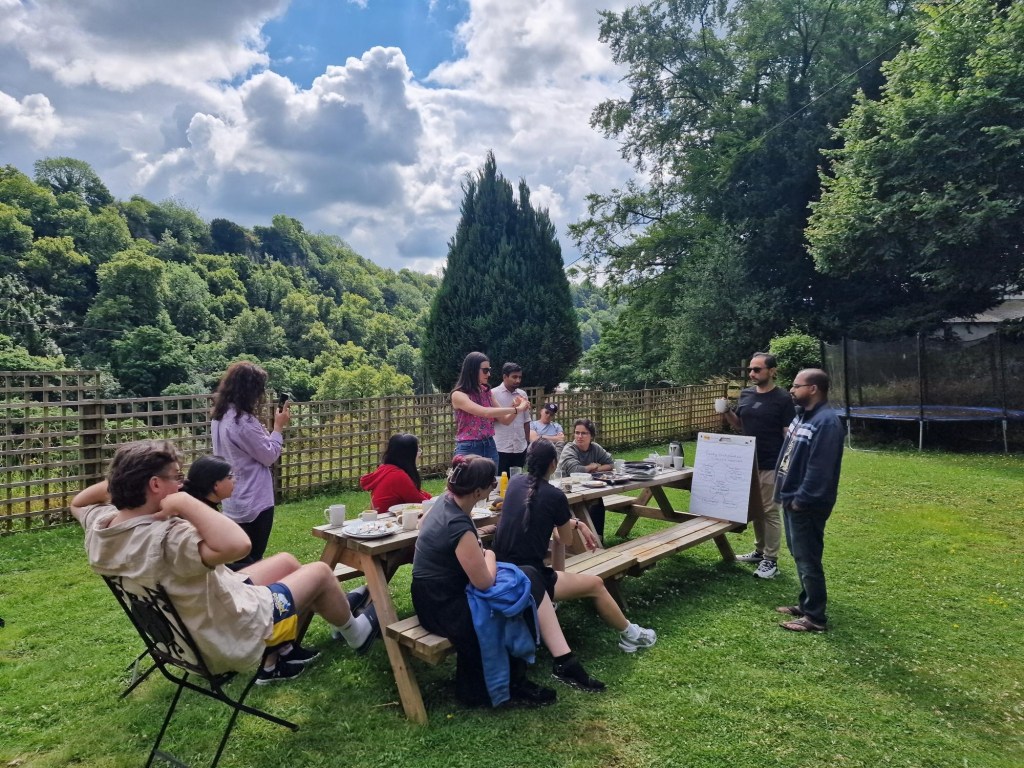
Our group lived, ate, worked, and enjoyed downtime together. We spent time getting to know each other which led to interesting and useful conversations in comfortable settings. We exchanged research ideas, culinary discoveries, and some even became language-learning buddies.
We formed into three groups based on our interests and generated three research themes:
- Biomechanics, Injury, and recovery
- Assistive technology for older adults
- Navigational platform for isolated communities
We developed our ideas into project presentations, with support from our expert visitors, and we delivered our three project ideas on the final day, Thursday July 18th, to a panel of invited reviewers.
Sessions included a professorial clinic to support ideation with Professor Praminda Caleb-Solly, a Responsible Research and Innovation session (RI Cards) followed by yoga with Professor Elvira Perez Vallejos, and a legal session addressing IP and robotics from Assistant Professors Joanna Wisniowska and Natalie Leesakul.
There was an opportunity, as part of an impact session with Lynn Rees and Hazel Sayers, to contribute to this blog through short interviews and photos. Quotes illustrate residents’ experience.
Q: What have been your experiences of the event so far?
A: “The communication feels very natural because you get used to the people that you’re with. So for example, yesterday after the work day, there were 3 of us sitting together and we naturally just starting pinging ideas between each other for research topics and right now we’re writing all of that up now this morning as a project proposal.”
A: “It feels relaxing as it’s a really nice retreat but I’m still working 24/7, however it doesn’t feel like it!”
A: “I think it’s made us less stressed because when you are in a university environment you are like thinking, what we should do, what we should improve and stuff, but here it’s quite chilled and made us feel better in terms of like, coming up with some new ideas.”

Q: What interested you about this event?
A: “One thing that sold this to me was that there’s going to be expertise from lots of different backgrounds and demographics and areas and I think that’s always something in science that you need to understand. Different populations have different problems and it’s not right to exclude any.”
A: “I was looking for this kind of environment where you could collaborate with people from different backgrounds because working on AI in a healthcare setting you need to have expertise from different backgrounds. It’s not just an AI expertise that does everything. This is a very good opportunity to interact with people from different backgrounds.”
A: “I’m interested in how AI can be equitably deployed in the healthcare settings and the comparison between the US and UK health systems and the EU context of responsible AI – the big picture level.”

By the end of the week, we had formed dedicated project teams. On July 18th, we were very grateful to receive considered feedback from our reviewers, Helena Webb (Assistant Professor, RAi-UK, Horizon, Computer Science, UoN), Armaghan Moemeni (Assistant Professor, Computer Science, UoN), Michael Craven (Principal Research Fellow, MindTech, Engineering, UoN), and David Hawker (Senior Research Manager, Faculty of Science, UoN). Our reviewers’ feedback was comprehensive, and overall, very positive. All teams took note of advice given and suggestions made to further improve their projects. We laid the groundwork for continued collaboration and research, with Slack groups created around individual projects and plans made to work over the following weeks.

The quality and potential impact of the project ideas we incubated evidence HEAD Residency’s success. By fostering an environment where participants could freely share ideas and expertise, we successfully produced research initiatives to address critical gaps in healthcare technology and public health while simultaneously fostering and nurturing networks of relationships. We expect the relationships and networks formed during this week to extend beyond the program, contributing to our sustained effort toward achieving HEAD’s long-term goals.
One of the teams formed at the residency – HEADS UP – already has a paper underway and are busy working on desk research tasks and exploring options for funding a larger project. A number of residents are looking forward to seeing one another again at the TAS symposium at the University of Texas at Austin, in September.

Residents included Shadab Mashuk, Natalie Leesakul, Krishika Khemani, Yang Lu, Matt Kammer-Kerwick, Beyza Yazgan Dagli and Ali Cihan Dagli.