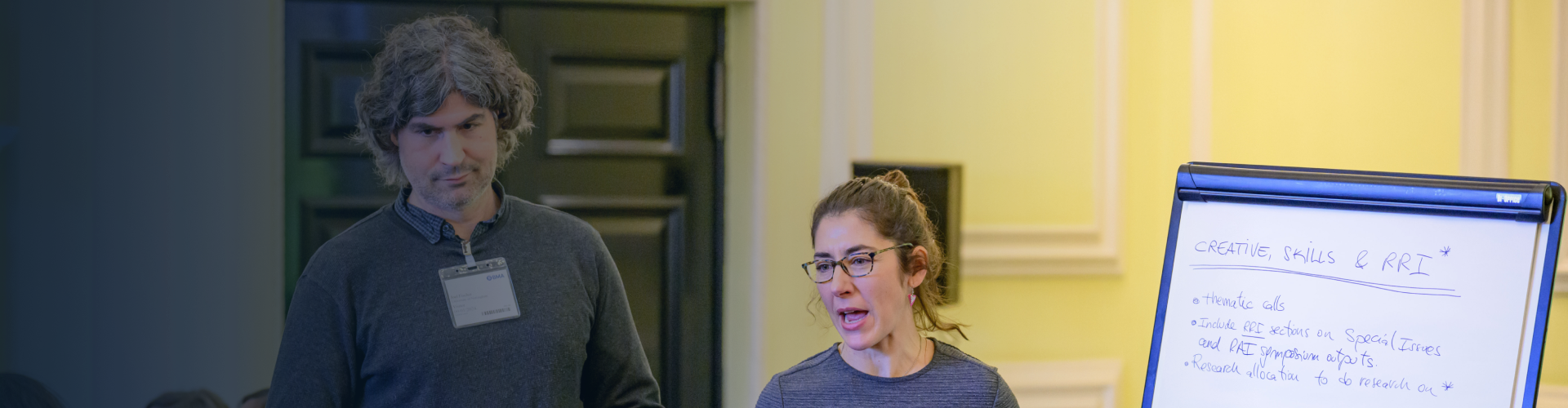
Responsible Research and Innovation (RRI) means doing research in a way that anticipates how it might affect people and the environment in the future so that we can gain the most benefit and avoid harm. RRI is at the heart of the RAi UK research programme.
Responsible Research and Innovation (RRI) invites researchers and innovators to consider the bigger picture, including the long-term impacts of their work and its value to society. Different definitions of RRI emphasize different things, but they all highlight concerns that can be overlooked or undervalued, even by good researchers. For example, Von Schomberg (2013) highlights:
Note that Responsible Research and Innovation overlaps with, but is not the same as:
Here are some more definitions of Responsible Research and/or Innovation:
“Responsible innovation means taking care of the future through collective stewardship of science and innovation in the present.” p1570 – Stilgoe et al (2013) Developing a framework for responsible innovation, Research Policy, Volume 42, Issue 9 Pages 1568-1580, https://doi.org/10.1016/j.respol.2013.05.008
‘Responsible Research and Innovation is a transparent, interactive process by which societal actors and innovators become mutually responsive to each other with a view on the (ethical) acceptability, sustainability and societal desirability of the innovation process and its marketable products (in order to allow a proper embedding of scientific and technological advances in our society)’ p9 – Von Schomberg, R. (Ed.). (2011). Towards Responsible Research and Innovation in the Information and Communication Technologies and Security Technologies Fields. Luxembourg: Publication Office of the European Union. Retrieved from https://op.europa.eu/en/publication-detail/-/publication/60153e8a-0fe9-4911-a7f4-1b530967ef10
Practicing Responsible Research and Innovation:
Practicing Responsible Research and Innovation typically includes:
For more information…
Marina Jirotka, Barbara Grimpe, Bernd Stahl, Grace Eden, and Mark Hartswood. 2017. Responsible research and innovation in the digital age. Commun. ACM 60, 5 (May 2017), 62–68. https://doi.org/10.1145/3064940
Paul Root Wolpe. 2006. Reasons Scientists Avoid Thinking about Ethics. Cell, Volume 125, Issue 6, 1023 – 1025. https://doi.org/10.1016/j.cell.2006.06.001
The EPSRC AREA framework highlights four key activities involved in “doing” RRI:
There are LOTS of different tools and resources available to help with RRI. Sometimes the biggest problem is deciding where to start. The RRI Prompts and Practice cards provide a simple starting point if you want to start thinking about what RRI could mean for your research.
But fundamentally, RRI is an ongoing process in which you ask yourself (and your colleagues):
What are we going to do now to make our research ‘more responsible’?
Here are some more specific questions to consider in relation to RRI:

As a researcher, you can do a lot to make your research responsible, but there are some things that you can’t do as a lone researcher. RRI will be most effective if:
So you may need to ask other people for support, and perhaps you could act as a local “champion” for RRI.
For more information…
Virginia Portillo, Peter Craigon, Liz Dowthwaite, Chris Greenhalgh, Elvira Pérez-Vallejos (2022). Supporting responsible research and innovation within a university-based digital research programme: Reflections from the “hoRRIzon” project. Journal of Responsible Technology, Volume 12, 100045, ISSN 2666-6596. https://doi.org/10.1016/j.jrt.2022.100045
It is important to start considering Responsible Research and Innovation as early as possible in the process of developing a new project proposal. Many important decisions are made by the time the project is actually approved/funded.
Many funders also expect or require some elements of RRI to be evidenced in the proposal (for example, Patient and Public Involvement for medical projects). You should check for specific guidance or requirements related to the funder or funding call.
We have found it useful to:
We have found that discussing this subset of questions based on the AREA-Plus framework is a good way to start thinking about RRI issues when developing a new project proposal:
We suggest that you set aside about 1 hour to do this as a proposal team. Ideally including other stakeholders, or repeat the exercise with them.
An RRI Action Plan is just a clear statement of what you are going to “do” in terms of RRI and why. An exercise like the one above can help to identify project priorities for RRI.
It is important to make the plan concrete, e.g. dedicating time and resources to specific activities that will address your RRI priorities.
The RRI Prompts and Practice cards – and many other RRI tools and resources – may help you to identify and plan RRI-related activities.
Here are some links to useful tools and resources to help with RRI:



Join us as an official partner if your organisation is interested in Responsible AI research, innovation and skills. We are looking for partners including businesses, funders, charities, creative organisations, industry associations, think tanks and more. Find out more and sign up
RAi UK will store your data in accordance with the General Data Protection Regulation 2017 (GDPR). We will not share your data with any third parties and you are given opportunities to unsubscribe at any time within the electronic communications you receive, or by emailing info@rai.ac.uk