

DOMINOS: Disruption Mitigation for Responsible AI
by Radu Calinescu, project lead (University of York); Lina Marsso (University of Toronto’s Schwartz Reisman Institute for Technology and Society, and Polytechnique Montreal), and Isobel Standen (University of York)
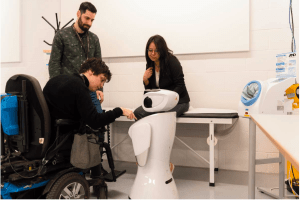
The DOMINOS international partnership between the University of York’s Institute for Safe Autonomy and the University of Toronto’s Schwartz Reisman Institute for Technology and Society is focused on enabling AI systems to remain observant of the human norms and values as they adapt to overcome the disruptions affecting their operation.
Our ambitious plan to deliver a methodology for diverse stakeholders to co-develop AI solutions capable of mitigating disruptions without violating social, legal, ethical, empathetic and cultural (SLEEC) norms could only be achieved by embedding RRI and EDI principles at all stages of the project. To that end, the project activities were planned, and are being carried out by a gender and seniority-level balanced and geographically distributed research team covering disciplines ranging from Computer Science and Social Psychology to Law, Ethics and Philosophy. This work has also kickstarted the first annual workshop on Requirements Engineering for Trustworthy Artificial Intelligence (RETRAI), which will bring together researchers from humanities, social sciences, computer science and industry – also involving many of our DOMINOS early-career researchers.
To ensure the practical relevance and broad accessibility of our research, we engaged closely with stakeholders from application domains as diverse as health and assistive care, environment protection, automotive and manufacturing. At each stage of the project, we assessed the potential impact of this work, including how we could leverage our research to shape real-world solutions and best practices, both of which could only be achieved through regular conversations with stakeholders. We leveraged our engagement with robotics engineers, medics, professional carers, patients and the general public to explore SLEEC-relevant disruptions for our embodied-AI applications for Emergency Department patient triage (DAISY), and home assistance to people with mild physical and cognitive impairments (ALMI). We initiated an ongoing dialogue with foresters, sociologists, ethicists and lawyers to understand the implications of disruptions that might be encountered in our embodied-AI solution for forest health management (ASPEN). These efforts led to the co-creation of adiverse repository of use cases, which we made freely available online, enabling early feedback, reproducibility of, and equal access to our DOMINOS outputs. The repository, along with the processes and tools we have developed throughout the project, have been presented in a tutorial at the flagship software engineering conference ICSE’2025 and will be hosted again at leading requirements engineering conference RE’2025. These tutorials reflect our DOMINOS team’s commitment to broad dissemination, inclusive public dialogue, and the integration of expert opinion beyond the immediate project team.
The AI disruption methodology we developed exploiting this use case repository and the insights gained while assembling it is currently being validated within a study with diverse participants representative of its intended technical and non-technical users. We will use the lessons learnt from this study and the direct feedback from the participants to improve the methodology and its tool support prior to their broad, open dissemination.