
WATCH THE MEETING HIGHLIGHTS
Implementing Responsible AI in the NHS
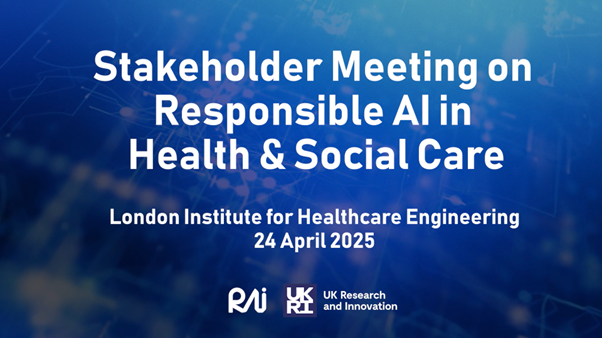
On 24 April 2025, the Responsible AI UK Health and Social Care Working Group convened senior leaders from across the healthcare ecosystem, at the London Institute for Healthcare Engineering. The session brought together 27 stakeholders from NHS trusts, government agencies (DHSC, MHRA, Scottish and Welsh Governments), academic institutions, industry, and patient advocates, to explore how to accelerate responsible AI adoption across the NHS.
The discussion was framed by the urgent need for innovative and potentially disruptive change to the UK healthcare system, described by one participant as “not just smoking, it’s on fire”, to provide the quality care we strive for our patients. Artificial intelligence was recognised as a potential solution to challenges we currently face, and a critical part of the three major shifts outlined in the 10 Year Health Plan.
The group explored four priority areas, highlighting current challenges, sharing insights from across the system, and identifying opportunities for coordinated development and action:
1. Governance and evaluation:
- • A ‘single frictionless’ implementation pathway was proposed, with an ‘assessed once, adopted everywhere’ model to reduce duplication and accelerate safe deployment.
- • Enhanced use of regulatory sandboxing mechanisms (e.g. MHRA AI Airlock), could expedite and improve the approvals process.
- • Fragmented decision-making within NHS organisations results in inconsistent adoption, with current evaluation frameworks often prioritising technical performance over real-world value; a national technology formulary could support consistent evaluation and adoption.
- • Value demonstrated in one setting may not translate to another, as the challenge often lies not in the technology itself but in its implementation.
- • Closer collaboration with industry could accelerate regulatory approval and aid adoption, though improved guidance is needed for on ongoing monitoring and post-market surveillance.
2. Funding and procurement:
- • Short-term, project-based funding creates sustainability challenges, making it difficult for organisations to justify AI investment without robust evidence. Generating the necessary evidence requires substantial upfront investment, yet current funding models heavily favour innovation and research over implementation and adoption. Greater allocation of funding should be directed toward adoption, with an initial focus on non-clinical AI.
- • It was also suggested that funding should be problem-focused, to aid successful adoption, rather than solely driving innovation.
- • Exploring centralised procurement through national or regional bodies could help leverage economies of scale while addressing local resource constraints.
3. Workforce readiness:
- • Healthcare professionals demonstrate varying AI literacy levels. Participants noted the absence of AI education in current medical curricula and significant workforce concerns exist about AI potentially displacing traditional clinical roles, which remains a major implementation barrier.
- • To address these challenges, participants recommended developing AI education programmes spanning undergraduate level through to continuing professional development. These could be formally incorporated into registration requirements and revalidation processes by professional regulatory bodies.
- • Establishing networks that connect Centres of Excellence with local centres could support the sharing of best practice and implementation expertise and mitigate the risk of inequity across the health service.
- • Effective change management with the workforce is key, particularly if care pathways need fundamental transformation to realise the benefits of AI.
4. Health equity considerations:
- • Significant variations exist in AI implementation capabilities across organisations and geographical regions, with participants highlighting inequalities within the NHS.
- • A significant potential bottleneck lies in interfacing within IT systems and targeted infrastructure investment would be needed to address regional disparities in AI readiness.
- • Mapping each NHS organisation’s AI maturity and supporting those with lower readiness could help close capability gaps and resulting inequalities.
- • AI products should actively target existing healthcare inequalities, rather than simply avoiding their exacerbation.
- • Understanding which communities may opt-out of data sharing is essential to ensure inclusive development and deployment.
- • Patients, the public, and clinicians should be meaningfully involved in shaping AI strategy at every step.
The meeting underscored that while technical AI solutions offer significant potential for addressing healthcare challenges, successful implementation remains limited. Systematic change is needed across governance, funding and workforce development, underpinned by a strong commitment to equity. With the publication of the 10 Year Health Plan, a vision has been set. At Responsible Ai UK, our focus now turns to how this will be delivered, ensuring that responsible and inclusive AI becomes embedded across the NHS. Our formal response to the 10 Year Health Plan will be published shortly.
 24 April 2025
  1:00 pm - 5:00 pm GMT