
 Science, Innovation and Technology
 Collaboration Grant
Jadu Dash, Efstathios Margaritis, Rachel Higgins


Geospatial AI has rapidly advanced through foundation models such as the NASA–IBM Geospatial Foundation Model and the growing availability of open satellite, crowdsourced and street-level imagery. These technologies enable applications from land-use mapping to disaster response and mobility analysis, but also raise concerns about privacy, bias, governance and ethical deployment. This project built a new Community of Practice on Responsible GeoAI in collaboration with Ordnance Survey and other industrial partners. Activities included workshops at Ordnance Survey, expert roundtables, case-study development and drafting sessions to co-create a practical Responsible GeoAI Framework, supporting national ambitions for ethical geospatial data use and governance. Operational insights from industry were provided by Amazon Web Services.
Outcomes include:
Collaborating with Ordnance Survey.
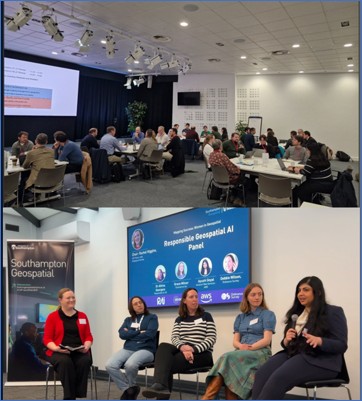
Completed activities included a literature, standards and framework review; workshop; targeted expert interviews; a Responsible GeoAI panel at the Women in Geospatial event on the 10 of March 2026; and structured review of the white paper with OS and AWS feedback tracked through an internal traceability annex.
How can we build trustworthy Geospatial AI? This was the key question asked at the GeoAI workshop held on 2 February 2026, where the project team were joined by around 40 participants from Ordnance Survey, academia and policy leaders. The workshop aimed to bring together key stakeholders to explore critical themes such as data provenance, spatial bias and location privacy. Eventbrite page.
The principal output is a Responsible GeoAI framework and white paper that translates Responsible AI principles into geospatial field. The framework is organised around four connected pillars – Technical Integrity and Robustness; Legal and Ethical Assurance; Responsible Innovation and Governance; and Societal and Sustainable Impact – supported by lifecycle governance, risk-tier pathways, assurance artefacts that can be captured in a new GeoAI Transparency Passport. Crucially, the framework emphasises that its true value relies entirely on the interconnected interaction between all four pillars rather than looking at any single one in isolation. The outcomes extend beyond a written framework. The project has reframed Responsible GeoAI as an operational assurance challenge across data, models, platforms, people, decisions and downstream use. It has also strengthened the case for treating spatial leakage, temporal persistence, place-based collective harm, transferability failure and documentation of AI intervention as practical governance concerns rather than abstract ethical issues.

Our Responsible Geospatial AI Framework was showcased through engagement at the AWS Geospatial Day in London and GeoBusiness, where discussions highlighted the growing need for practical guidance on trustworthy, transparent and accountable GeoAI. The framework responds to a clear sector gap: organisations are rapidly adopting AI enabled geospatial tools, but many still lack shared standards for responsible use, documentation and public confidence. Interest is now extending beyond the UK, with the FOSS4G 2026 organising committee expressing interest in featuring the framework in Hiroshima. The project is also developing a proof of concept for a GeoAI Transparency Passport.
Emerging impact is both practical and conceptual: the project has given organisations that create, procure or rely on geospatial AI a shared vocabulary, a proportionate risk approach and concrete assurance mechanisms that can be tested in real workflows.


Join us as an official partner if your organisation is interested in Responsible AI research, innovation and skills. We are looking for partners including businesses, funders, charities, creative organisations, industry associations, think tanks and more. Find out more and sign up
RAi UK will store your data in accordance with the General Data Protection Regulation 2017 (GDPR). We will not share your data with any third parties and you are given opportunities to unsubscribe at any time within the electronic communications you receive, or by emailing info@rai.ac.uk