

Responsible Innovation into action: RAKE engagement with the business sector
By Prof Rob Procter (University of Warwick) and Dr Virginia Portillo (University of Nottingham) on behalf of the RAKE project
The following of Responsible Innovation (RI) principles by software development teams involves collaboration, foresight, considering possible impacts on people and the environment, and possible actions teams might to take in response to these impacts. RI’s impact is therefore central to ‘responsible’ AI, but RI training and interdisciplinary practices must be developed to provide robust mechanisms for creating and assessing responsible AI.
To this end, the RAKE (Responsible Innovation Advantage in Knowledge Exchange), a RAi UK Impact Accelerator project, is working to consolidate existing experience and resources to work with funders, businesses, projects, Centres for Doctoral Training and university spinouts. This involves investigating how RI can be better embedded within these pipelines to improve AI development and deployment. It aims to build on past work to support a new generation of RI-in-practice, strengthening RAi-UK’s responsible AI research agenda.
As part of its research, RAKE has been working with software project delivery managers (DMs) in a digital services company to explore the use of Responsible Innovation Prompts and Practice cards (RI Cards). RI Cards are designed to highlight 16 different aspects of RI, each of which poses key questions and prompts for action for DMs to then consider (Portillo et al., 2023).
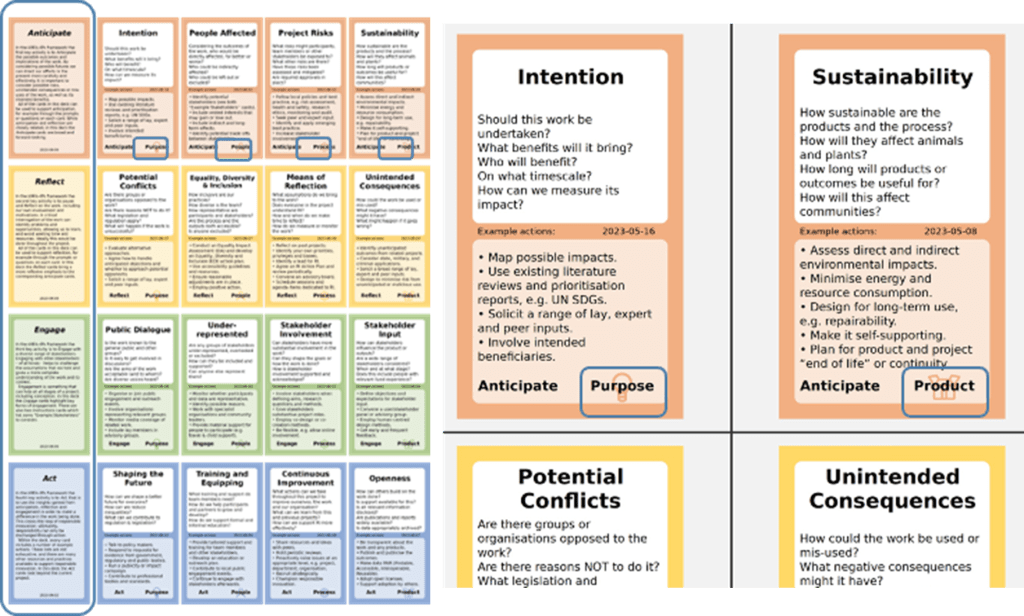
Responsible Innovation Prompts and Practice Cards (RI Cards) (Version 3.1.1, November 2023).
DMs were asked to use the RI Cards for 8 weeks within their projects with their teams and/or their clients, and to report their experience by completing a brief anonymised feedback form each week. This included questions on the kinds of concerns or reflections raised by using the RI Cards, and actions (if any) that were then taken in response, what worked well, what worked less well and why.
The feedback we have received so far from DMs and their teams has been very positive. The RI Cards were valued personally and professionally by DMs, and their teams felt empowered to innovate in the “right way”, providing structure, encouraging reflection, decision making and creation of a RI action plan. Project’s context was vital, and some DMs and their teams have also made suggestions as to how the RI Cards could be improved to be a better fit with their needs.
These preliminary findings have led the company to express an interest in incorporating the RI Cards and the lessons learnt for their RI practice into their own Delivery Toolkit to support DMs putting RI into practice throughout the project life cycle, and strength the company’s current and future embedded RI culture.
We are now running a post-study feedback questionnaire with all the DMs that took part in this study. The findings will feed into RAKE’s RI guidelines to the AI business sector.
Portillo, V., Greenhalgh, C., Craigon, P. J., & Ten Holter, C. (2023, July). Responsible Research and Innovation (RRI) prompts and practice cards: A tool to support responsible practice. In Proceedings of the First International Symposium on Trustworthy Autonomous Systems (pp. 1-4).