

When we started the RAi UK programme in 2022, the big question for our skills agenda was one about adoption. How can we help people and organisations learn to use AI in a responsible way, to maximise the benefits it has on our lives, whilst minimising the harm? Indeed, most skills initiatives focus on a similar objective: how can people use these tools? What skills do people need to use AI safely, responsibly and equitably
Recently, however, the tide has clearly shifted. People aren’t anxious about learning to use AI tools, they’re anxious about the impacts it’s having on their jobs, their children’s futures, and on fairness in our society. New research published by King’s College London’s Policy Institute and Institute for Artificial Intelligence found that seven in ten of the UK public (69%) worried about job losses from AI, and just 7% think its benefits will be shared fairly. Another recent report showed that people in the UK are pushing back against AI, with attitudes towards AI becoming more negative in the past three years. Main concerns for limiting personal use of AI are data privacy, security, compliance, and broader social implications.
These questions can’t be answered alone, and certainly not alone in front of a screen by yourself. This is why a narrow idea of AI skills as individual competencies focused on using AI is not enough. Learning to question AI, not only its outputs but its impacts on our lives and society, is so important. Learning to question AI is a collective practice that needs education that is critical, collaborative and oriented around agency and citizenship.
The AI Skills Hub and the policy conversation around it
The AI Skills Hub platform was launched in January 2026, as part of the UK government initiative aiming to equip 10 million workers with AI skills by 2030. It responds to real evidence: government research found only 21% of UK workers feel confident using AI at work, and only around one in six UK businesses were using AI as of mid-2025, with micro-businesses far less likely to adopt it than large firms. The platform offers industry-developed training, free to access, initially targeting four high-growth sectors.
Importantly, its courses are benchmarked against a government framework, “AI Foundation Skills for Work”, which spans technical, non-technical, responsible and ethical skills. It sits alongside the more detailed AI Skills for Business Competency Framework from The Alan Turing Institute, which names ethical and responsible engagement as a core competency. Responsible AI principles are present in the architecture. What is far less clear is how they are actually fostered in practice, and whether these opportunities enable public discussion about contestable questions about AI’s role in society. Moreover, our previous evaluation of online RAI learning resources, many of which are offered through the Hub, found considerable variation in quality, accessibility, and often provided overly generic content.
The wider policy conversation has begun to probe this issue as well. Commentators flagged the Hub’s reliance on US Big Tech firms as its main training providers, a lack of clarity around paid resources, and a need for independent initiatives that are genuinely accessible to all. When the dominant providers of “AI literacy” are the same firms capturing the value of AI, the tendency will be to teach citizens how to use those firms’ products well, not how to think critically about the technology’s place in their lives.
Lessons from the AI&Us Alliance
This year we piloted the “AI&Us Alliance” initiative, for which we put together a toolkit of co-designed educational resources and learning activities originally produced by RAi UK Skills projects, to be used in public events with people of all ages. These resources are designed to be easy to facilitate, requiring little or no technology, and providing information and reflective questions about AI for people without technical backgrounds.
At our three initial AI+Us events, we watched as families and friends from diverse age groups engaged in the activities together and making sense of what is AI and the impacts it has on their lives, from enthusiasm to concerns about how AI comes to play in their day to day. Through creative activities, attendees created drawings about assumptions and decisions ‘inside’ AI. Through card games, attendees learned about different types of AI e.g., Generative AI, Recommender AI and Decision-Making AI, and supervised training. Attendees were also presented with AI-generated outputs and asked to test whether they could differentiate AI text from human text and consider how well AI images represented various cultures. Supporting people from different generations to interact with each other while learning about AI was particularly helpful because the understanding and impacts of AI are not experienced in the same way by people across society, and yet decisions regarding its development and deployment influence everyone.
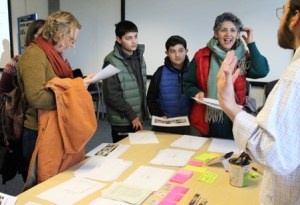
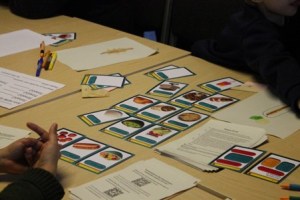
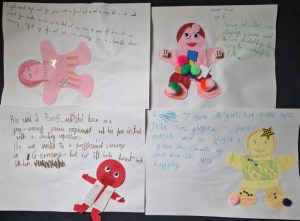
Our initial experiences piloting these events show that there are no silver-bullet resources or approaches for AI upskilling and AI literacy. What matters is getting together and making space for conversations to unfold, beyond course platforms for individual use. Coming together to show that we stand for positive change, and to work out what that change might look like when it is not yet clear, needs exactly this kind of collective space and debate.
Widening Participation in AI Literacy
Beyond the AI&Us Alliance, other RAI UK programme members have taken similar initiatives. The Playful AI literacy project collaborated with libraries, schools, home-education groups, and families in Northeast England to incorporate AI literacy activities into communities. Activities included games where participants evaluated AI-generated answers for trustworthiness or bias, helping them understand AI and responsible use. Delivering activities outside classrooms increased participation by creating informal, welcoming spaces where children felt comfortable sharing their experiences with AI. Teachers highlighted the importance of connecting AI literacy to local issues such as racism and misogyny, showing how libraries and communities can support accessible AI learning.
Creating educational materials should include the target audiences, as shown by the GenAISiS project, which worked with young people to develop AI literacy activities. These co-created resources featured fictional characters, cartoons, and activities focused on academic integrity, information literacy, and critical thinking. Students played a central role in designing resources for other young people, granting them a direct voice in how AI literacy is taught. The project also recognised school librarians as key partners in promoting responsible AI and developed an open toolkit that could be shared more widely through workshops.
Similarly, the Let’s Talk AI project used co-created resources and a public campaign to promote discussions about AI within communities and homes, through bus stops, libraries, radio, and social media. It involved direct engagement with the public to learn about their interests in AI topics and their preferred ways of learning. By incorporating real community members and their personal experiences into webtoon stories, the initiative sought to present AI as relevant and accessible, particularly for individuals less inclined to participate in technical AI conversations.
Who is Responsible for Responsible AI Literacy?
As members of the universities leading on these initiatives, we are aware of both our potential and appetite to play a more active role in fostering this space for debate, dissent and socio-technical understanding of AI. But we are also under pressure to demonstrate clear impact and immediate results, and many of us work in universities facing financial instability. This kind of work does not produce the clean, countable impact of a completed course or a certified worker, and its value shows up slowly, in communities better able to question and shape the technology around them. But that is precisely why it will not happen without public investment.
So, we call on people and communities to seek out and join these conversations wherever you find them, in workplaces, schools, community halls and online. AI literacy is not something you complete alone in front of a screen. It is something we build together, by questioning, disagreeing and deciding what we will and will not accept.
If you are interested in running your own AI&Us event, an event kit is now available by request and will be on our website. If you would also like to share your own event taking place for wider dissemination, please contact tubah.sarwar@kcl.ac.uk. This can help give visibility to your activities and connect with the network working in this area.
Acknowledgements
With contributions from in alphabetical order: Abbott, Y Pamela; Andrei, Oana; Ball, Brian; Barnard, Pepita; Bentley, Caitlin; Brown, Amy Aisha; Carr, Leslie; Garasto, Stef; Klyshbekova, Maira; Nabi, Syed Waqar; Naiseh, Mohammad; Reyes-Cruz, Gisela.
For more information about our evaluation of online AI resources, see: Klyshbekova, M., Cruz, G.R., Bentley, C., Garasto, S., Brown, A.A., Aicardi, C., Ball, B., Naiseh, M. and Andrei, O., 2025. A UK perspective on responsible education for responsible AI: a multidisciplinary review and evaluation framework. Journal of Responsible Technology, p.100147. https://www.sciencedirect.com/science/article/pii/S2666659625000435